
Stop Sign Ticket Ontario: $110 Fine & 3 Demerit Points

Last Updated:
| 9 Minutes To Read

Navigating the roads of Ontario requires not just a driver’s license but a deep understanding of road safety and traffic laws. Stop sign violations represent a significant portion of traffic tickets issued. Understanding the nuances of a stop sign ticket in Ontario can help drivers avoid hefty penalties and safeguard their driving privileges.
What is a Stop Sign Ticket in Ontario?
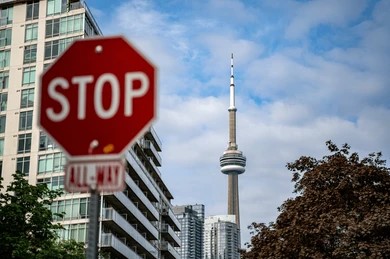
A stop sign ticket is issued to drivers who fail to make a complete stop at a stop sign. In Ontario, the law requires drivers to come to a complete stop at the nearest of the following: the marked stop line, before entering the nearest crosswalk, or at the point nearest the intersection where the driver has a clear view of approaching traffic before entering it.
Legal Definition of a Stop Sign Violation Under the Highway Traffic Act
The Highway Traffic Act of Ontario clearly defines the expectations for drivers approaching a stop sign under Section 136.1. According to this section, it’s defined as:
Every driver or street car operator approaching a stop sign at an intersection,
(a) shall stop his or her vehicle or street car at a marked stop line or, if none, then immediately before entering the nearest crosswalk or, if none, then immediately before entering the intersection; and
(b) shall yield the right of way to traffic in the intersection or approaching the intersection on another highway so closely that to proceed would constitute an immediate hazard and, having so yielded the right of way, may proceed.

Fines and Penalties for Disobeying a Stop Sign in Ontario
Disobeying a stop sign in Ontario is not taken lightly. The fines and penalties are structured to deter drivers from taking such violations lightly:
- Fines: The set fine for disobeying a stop sign in Ontario is $110. However, if you choose to fight the ticket and are found guilty, the fine can be up to $500.
- Demerit Points: A conviction will also result in three (3) demerit points added to your driving record.
- Impact on Insurance: Accumulating demerit points can significantly increase your insurance premiums. Some insurers may even classify you as a high-risk driver.
- Licence Suspension: For new drivers, accumulating too many demerit points can lead to a license suspension. For more experienced drivers, this might come after more points have been accumulated.
Real-Life Example
Consider the case of John, a seasoned driver in Toronto who thought he had come to a complete stop but rolled through a stop sign right in front of a police officer. John received a ticket and noticed a subsequent rise in his insurance premiums after the demerit points were applied to his record.
How Long Do You Have to Stop at a Stop Sign in Ontario?
The Highway Traffic Act does not specify an exact number of seconds that you must stop at a stop sign. What it does require is a complete stop, meaning your vehicle must come to a full and complete standstill before you proceed.
In practice, most driving instructors and officers consider a complete stop to be approximately 3 seconds. This gives you enough time to bring the vehicle to a full stop, check for traffic and pedestrians, and then proceed safely. If your wheels are still moving, even slightly, that is not a complete stop, and you can be charged.
The most common way drivers receive a stop sign ticket is by performing a rolling stop, where the vehicle slows down but never fully stops. This is enough for an officer to issue a ticket, even if you checked for traffic and proceeded safely. If you have received a ticket for failing to make a complete stop, contact us at 905-738-7171 for a free consultation.
Rolling Stop Ticket in Ontario
A rolling stop is when a driver slows down at a stop sign but does not bring the vehicle to a complete standstill before proceeding. In Ontario, a rolling stop is treated the same as running a stop sign. If an officer observes your vehicle still moving when you enter the intersection, they can issue you a ticket.
The penalties for a rolling stop ticket are the same as any stop sign violation: a set fine of $110, three (3) demerit points, and a conviction that stays on your driving record for three years. Your insurance rates may also be affected.
Rolling stop tickets are one of the most commonly fought traffic tickets in Ontario because many drivers genuinely believe they stopped. If you received a ticket for a rolling stop, there are several ways to challenge the charge. The officer’s vantage point, the angle of observation, weather conditions, and the exact location where they were positioned can all be factors in building your defence.
Longevity of a Stop Sign Ticket on Your Driving Record
When you receive a stop sign ticket in Ontario, it’s not just the immediate financial penalty and demerit points you need to worry about; the ticket also has a lingering effect on your driving record. Understanding how long this ticket impacts your record is crucial for managing your insurance premiums and maintaining a clean driving history.
Duration of the Ticket on Your Record
In Ontario, a stop sign ticket will stay on your driving record for three years from the date of conviction, not the date the ticket was issued. This is an important distinction because the process of fighting the ticket can sometimes delay the conviction date.
How to Fight a Stop Sign Ticket in Ontario
Fighting a stop sign ticket may seem daunting, but with the right approach and legal advice, it is possible. Here’s a structured guide to contesting your ticket:
1. Understand the Charge
Read the ticket carefully. Understand what you are being charged with and the evidence against you. This is crucial in planning your defence.
2. Gather Evidence
Collect any evidence that could support your case. This could include:
- Photographs of the stop sign and the surroundings.
- Dashcam footage, if available.
- Witness statements, if other people were present.
3. Consider Legal Representation
Consulting with a paralegal specializing in traffic tickets can provide a significant advantage. They can help you understand the intricacies of traffic law in Ontario and formulate a strong defence.
4. Preparing for Court
Prepare your testimony. Be honest and clear about what happened. Your paralegal can help prepare you for the types of questions you might face and how to answer them effectively.
5. Court Proceedings
On the day of the court, dress formally and arrive early. Show respect to the court, and be prepared to present your case clearly and calmly.

Preventing Future Violations
Prevention is always better than cure. Here are some tips to avoid future stop sign violations:
- Always come to a complete stop at the stop line.
- Pay attention to new stop signs, especially in areas where you drive regularly.
- Be aware of your speed as you approach a stop sign.
- Educate yourself regularly about traffic updates and changes in laws.
Understanding and respecting traffic signs is crucial for all drivers. If you find yourself with a stop sign ticket in Ontario, remember that you have options to contest it. With the right knowledge and preparation, you can effectively navigate the situation to minimize any negative impact on your driving record.
Remember, every stop sign is an opportunity to demonstrate your commitment to road safety. By adhering to the rules, not only do you avoid fines and demerits, but you also contribute to making our roads safer for everyone.
Frequently Asked Questions About Stop Sign Tickets in Ontario
Q: How much is a stop sign ticket in Ontario?
A: The set fine for a stop sign ticket in Ontario is $110. However, if you fight the ticket and are found guilty at trial, the fine can be up to $500. In addition to the fine, you will receive 3 demerit points, and the conviction will stay on your record for 3 years.
Q: How many demerit points for a stop sign ticket in Ontario?
A: A stop sign ticket carries 3 demerit points. These points stay on your driving record for 2 years from the offence date. For G1 and G2 novice drivers, accumulating demerit points can lead to a licence suspension.
Q: How long do you have to stop at a stop sign in Ontario?
A: The Highway Traffic Act does not specify an exact number of seconds. It requires a complete stop, meaning your vehicle must come to a full standstill. In practice, approximately 3 seconds is considered sufficient to stop, check for traffic, and proceed safely.
Q: Can you get a ticket for a rolling stop in Ontario?
A: Yes. A rolling stop is treated the same as running a stop sign. If your wheels are still moving when you enter the intersection, the officer can issue a ticket with the same $110 fine and 3 demerit points as any stop sign violation.
Q: Should I fight a stop sign ticket in Ontario?
A: Yes. A stop sign ticket adds 3 demerit points to your record and can increase your insurance rates for 3 years. The only way to avoid these consequences is to fight the ticket at trial and have the charge withdrawn or dismissed. A licensed paralegal can represent you in court so you don’t have to attend yourself.
Q: How long does a stop sign ticket stay on your record in Ontario?
A: A stop sign ticket conviction stays on your driving record for 3 years from the date of conviction, not the date the ticket was issued. The demerit points are removed after 2 years, but the conviction remains visible to insurance companies for the full 3 years.
Q: How to fight a rolling stop sign ticket in Ontario?
A: Select the trial option on your ticket and file it with the court within 15 days. Request the officer’s disclosure (their notes and evidence), and review it carefully. Factors like the officer’s vantage point, distance from your vehicle, and weather conditions can all be used in your defence. Your best chance is to hire a licensed paralegal who understands traffic court procedures
Related Articles:
- The Demerit Point System
- Traffic Tickets Toronto
- 11 Careless Driving Ontario Facts: Penalties & Fines
- 13 Stunt Driving Ontario Facts: Speed, Penalties & Fines
- 7 Red Light Ticket Ontario Facts: Camera vs Officer Fines
- Disobey Sign Ticket Ontario: $110 Fine & 2 Demerit Points
We’re Here to Help – Get Your Free Consultation Now
Your peace of mind is our priority. Book a free consultation with our dedicated legal team, and discover how we can assist you in achieving the best possible outcome.





Updated March 2026
2 Response(s) for “Stop Sign Ticket Ontario: $110 Fine & 3 Demerit Points”
Hello, if don’ stop fully in a stop sign (community zone) is there any chance i can file for not guilty? is there any impact on my insurance?
my charge is disobey stop sing-fail to stop-community safety zone section 136(1) (A)
is it okay to present to Court to support not guilty.. kindly advice..
+++++++
Your Worship, I respectfully plead not guilty to the charge under Section 136(1)(A) of the Highway Traffic Act. On the date in question, I approached the stop sign with caution and significantly reduced my speed. While I acknowledge that I did not come to a complete stop, I believed I was driving safely and responsibly. There were no pedestrians or cross traffic present, and I ensured the intersection was clear before proceeding.
I would also like to highlight that it was a school holiday, and there was no school-related traffic or pedestrian activity in the area at the time. I exercised judgment based on the conditions and acted with care.
Furthermore, I have an excellent driving record with no prior infractions. I take road safety seriously and have always made it a priority to follow traffic laws. This incident does not reflect my usual standard of driving, and I deeply regret the oversight.
I understand the importance of full compliance with stop signs, especially within a Community Safety Zone, and I assure the court that I have taken this experience as a learning opportunity. I respectfully request the court to consider my clean driving history, the context of the school holiday, and my cautious approach when evaluating the charge or penalty.