
Evict A Tenant for Not Paying Rent Ontario

Last Updated:
| 15 Minutes To Read
Is your Tenant not paying rent and leaving you stressed and frustrated?
As a landlord in Ontario, dealing with a tenant who refuses to pay rent can be overwhelming and financially draining. We get it, you want a swift and effective solution. That’s where we come in.
This guide will quickly walk you through the exact steps you need to evict a tenant for not paying rent in Ontario. From issuing the N4 notice to navigating the Landlord and Tenant Board, we’ll provide clear, actionable advice to help you regain control of your property.
Let’s dive in and resolve this together.

What a Landlord Can Do if a Tenant Does Not Pay Rent
When a tenant fails to pay rent, you have several options to address the issue legally and effectively.
Give the Tenant Notice to Pay Rent or Move Out
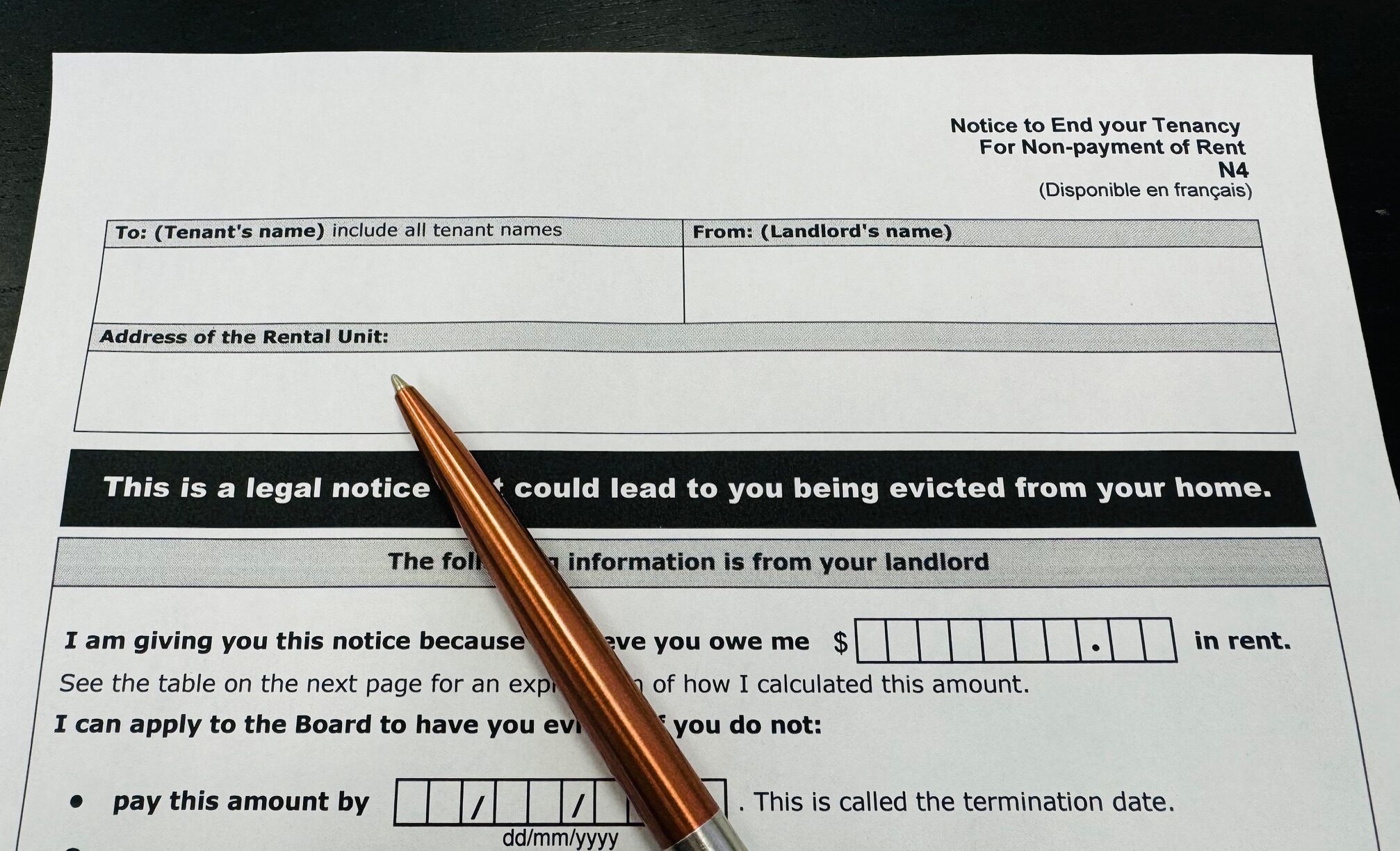
The first step is to serve the tenant with a Notice to End a Tenancy Early for Non-payment of Rent (N4 Form). This notice informs the tenant that they must pay the rent owed or vacate the property by a specific termination date.
Rules About Termination Dates
- Monthly Tenancies: Provide at least 7 days’ notice after serving the N4 form.
- Service Method Adjustments:
- Personal Service: 7 days’ notice.
- Courier: Add 1 business day (total of 8 days).
- Mail: Add 5 business days (total of 192 days).
Notice is Void if Tenant Pays
If the tenant pays all the rent they owe before you file an application with the Landlord and Tenant Board (LTB), the N4 notice becomes void, and the tenancy continues as usual.
Apply for Rent Owed and to Evict the Tenant
If the tenant doesn’t pay the owed rent or move out by the termination date, you can file an Application to Evict a Tenant for Non-payment of Rent and to Collect Rent the Tenant Owes (L1 Form) with the LTB.
Apply for Just the Rent Owed
If you prefer not to evict the tenant but want to collect the owed rent, you can file an Application to Collect Rent the Tenant Owes (L9 Form).
Attend the Hearing
After filing your application, the LTB will schedule a hearing. It’s crucial to attend and present all necessary documentation to support your case. The board will consider your evidence and make a decision regarding rent owed and possible eviction.

The Eviction Process for Evicting a Tenant for Not Paying Rent in Ontario
Handling non-payment of rent requires a systematic approach to protect your rights and property. This is how the eviction process would proceed.
Tenant Stops Paying Rent
As a landlord, if your tenant does not pay rent on the day it is due, you have the right to take immediate action. For example, if rent is due on the 1st day of the month and the tenant fails to pay, you can serve them with an N4 Form as early as the 2nd day of the month.
Issue the Eviction Notice – N4 Form
The N4 Form sets a termination date by which the tenant must pay the overdue rent or move out. If your tenant does not pay the rent owed by this termination date, you can apply to the Landlord and Tenant Board (LTB) to evict your tenant. Taking swift action not only emphasizes the importance of timely rent payments but also protects your rights and financial interests as a landlord.

The N4 Notice: Your First Step to Evict a Tenant for Not Paying Rent
The N4 starts every non-payment eviction in Ontario. You can serve it the day after rent is missed. For an N4 given on or after September 21, 2026, the termination date must be at least 7 days out. Add 5 business days if you mail it, or 1 business day if you courier it.
The N4 can list unpaid rent only, never utilities, damages, or fees. If the tenant pays everything owing before the termination date, the N4 becomes void. One wrong date or amount gets the whole application dismissed. Our N4 notice guide covers every field, the date math, and the 5 mistakes that sink cases. Call 905-738-7171, and we will serve it right the first time.
File an Application with the Board – L1 Application
As a landlord, the earliest date you can file the L1 Application is the day after the termination date specified in the N4 Form. For example, if the termination date on the N4 Form is November 17, you can file your L1 Application starting on November 18.
If your tenant does not pay the rent by the termination date, you have the right to escalate the situation by applying to the Landlord and Tenant Board (LTB) to evict your tenant. You can file your L1 Application, the official Application to Evict a Tenant for Non-payment of Rent and to Collect Rent the Tenant Owes. This application is filed online, so ensure that your N4 Form and Certificate of Service are correctly completed, scanned, and ready to be uploaded. Please note that to file the L1 Application, the tenant must still be living in the unit.
Negotiate a Payment Plan
An important new requirement established by the Landlord and Tenant Board is that you must attempt to negotiate a payment plan with your tenant before the hearing date. This step shows your willingness to resolve the issue amicably and can be beneficial during the eviction process.
Attend the Landlord Tenant Board Hearing
When you attend the Landlord and Tenant Board (LTB) hearing, the focus will be on the rent arrears owed by the tenant. You’ll present the amount you believe is owed, and the tenant will have the opportunity to agree or dispute this figure. Once the amount is determined, the member will decide whether to grant the tenant any relief, such as allowing a payment plan or providing additional time to pay off the arrears. Both you and the tenant will have the chance to present your cases regarding any proposed relief.
Enforcement of the Order
Once you have received your Landlord and Tenant Board (LTB) order, it’s important to take the necessary steps to enforce it. If your tenant does not move out by the date specified in the order, you have the legal right to engage the Sheriff’s office to carry out the eviction. Hiring the Sheriff ensures that the tenant is lawfully removed from your property, following all appropriate legal procedures. This enforcement step is crucial to uphold your rights as a landlord and to regain possession of your property.

Not all tenancies end peacefully. Sometimes a Landlord needs to take action and evict a tenant. We wrote the article 13 Reasons to Evict Your Tenant in Ontario, which details all the reasons you can evict your Tenant in Ontario beyond evicting them for non-payment of rent.

Most Common Reason to End a Lease with a Tenant Eviction:
- Non Payment of rent.
- Violating lease terms.
- Causing significant property damage.
- Engaging in illegal activities on the property.
- Interfering with the reasonable enjoyment of other tenants or the landlord.
About Sturino Walker Legal
At Sturino Walker Legal, we are a dedicated team of licensed paralegals committed to assisting landlords across Ontario. We specialize in landlord and tenant law, providing personalized and professional services to help you navigate complex legal processes.
Why Choose Us?
- Expertise in Landlord Tenant Law: With extensive experience, we understand the nuances of the Residential Tenancies Act.
- Personalized Service: We offer tailored advice and strategies based on your unique situation.
- Professional Representation: We represent landlords at LTB hearings to help achieve the best possible outcome.

What Happens If a Tenant Doesn’t Pay Rent and Moves Out?
If your tenant has left the rental unit but still owes you rent, you are not without options. Ontario law allows landlords to pursue former tenants for unpaid rent even after they have vacated the property.
You can file an L10 Application, an Application to Collect Money a Former Tenant Owes with the Landlord Tenant Board. This application allows you to recover the rent arrears that the tenant owes up to the date they moved out. You must file this application within one year of the tenant vacating the unit.
If the amount owed exceeds the LTB’s jurisdiction, or if you also wish to claim damages beyond rent arrears, you may need to pursue the matter through Small Claims Court. Our team can advise you on the best course of action based on your specific situation.
It is important to document everything: keep copies of the lease agreement, any communication with the tenant, records of missed payments, and photos of the unit’s condition when the tenant left. This documentation will be essential if you need to present your case to the Board or in court.
If your tenant has moved out and owes you rent, contact us at 905-738-7171 for a free consultation to discuss your options for recovering the money owed.
Frequently Asked Questions About Evicting a Tenant for Non-Payment of Rent
Q: What is an N4 notice in Ontario?
A: An N4 notice is the official Landlord Tenant Board form called the “Notice to End a Tenancy Early for Non-payment of Rent.” It is the first legal step a landlord must take when a tenant fails to pay rent. The N4 informs the tenant that they must pay all rent owed or vacate the rental unit by the termination date specified on the form.
Q: How soon can I serve an N4 notice after rent is missed?
A: You can serve an N4 notice the very next day after rent is due and unpaid. For example, if rent is due on the 1st and the tenant does not pay, you can serve the N4 on the 2nd. There is no waiting period before serving the notice.
Q: What happens if my tenant pays the rent after I serve the N4?
A: If the tenant pays all the rent they owe before you file an application with the Landlord Tenant Board, the N4 notice becomes void, and the tenancy continues. However, if you have already filed the application, the tenant must pay the full amount owed including the LTB filing fee to stop the eviction process.
Q: Can I evict a tenant for non-payment of rent if there is no lease?
A: Yes. The eviction process for non-payment of rent is the same whether there is a written lease or not. Under the Residential Tenancies Act, verbal and implied tenancy agreements are legally binding. The tenant is still obligated to pay rent, and you can still serve an N4 notice and file with the LTB.
Q: What is an L1 application?
A: An L1 application is the “Application to Evict a Tenant for Non-payment of Rent and to Collect Rent the Tenant Owes.” It is the form you file with the Landlord Tenant Board after the N4 notice period has expired and the tenant has not paid. The L1 requests a hearing where the Board will decide on the eviction and the rent owed.
Q: How long does an eviction for non-payment of rent take in Ontario?
A: On average, the entire process from serving the N4 notice to enforcing the eviction order takes approximately 75 to 150 days. This includes the 7-day notice period, waiting for a hearing date (typically 60 to 90 days), receiving the eviction order, and Sheriff enforcement if needed. Hiring professional representation can help ensure there are no delays caused by paperwork errors.
Q: What if my tenant owes rent and has moved out?
A: If your tenant has vacated the unit but still owes rent, you can file an L10 Application to Collect Money a Former Tenant Owes with the Landlord Tenant Board. This must be filed within one year of the tenant moving out. For larger amounts or claims beyond rent arrears, you may also pursue the matter through Small Claims Court.
Q: Does a Tenant Still Have to Pay Rent After an Eviction Notice?
A: Yes, your tenant is still legally obligated to pay rent even after you have served them with the N4 Form and filed the L1 Application. Serving the notice and initiating the eviction process does not absolve the tenant of their responsibility to pay ongoing rent as it becomes due. It’s important to continue monitoring rent payments during this period, as any additional unpaid rent can be included in your claim at the Landlord and Tenant Board (LTB) hearing.
Q: What if the tenant pays part of the rent they owe?
A: Partial payments do not void the N4 notice unless the full amount is paid before you file with the LTB. However, accepting partial payments may affect the amount you can claim.
Q: Can I change the locks if my tenant doesn’t pay rent?
A: No, changing locks without an eviction order from the LTB is illegal and can result in penalties.
Q: How can Sturino Walker Legal assist me?
A: Our team of licensed paralegals specializes in landlord-tenant disputes. We can guide you through the eviction process, ensuring all legal procedures are correctly followed to protect your rights.
Related Articles:
- How Late Can a Tenant Pay Rent in Ontario?
- 13 Reasons to Evict Your Tenant in Ontario
- Evict A Tenant for Personal Use in Ontario
- Landlord Legal Services Ontario
- N4 Notice Ontario: The 7 Steps To Serve It Right
- 9 Signs of an Ontario Professional Tenant
- L1 Application LTB: 9 Things to Know Before Filing
Protect Your Rights at the Landlord Tenant Board -Book a Free Consultation
Don’t go through the Landlord and Tenant Board process alone. Reach out for a free consultation with our skilled legal professionals who can guide you every step of the way.





6 Response(s) for “Evict A Tenant for Not Paying Rent Ontario”
Hi, Can a landlord issue an N4 and a shortly after that an N8 form? The reason for this is the tenant is not paying his rent and at the same time his lease is up the following month and we are not renewing it.
Please advice.
Thanks
Hello Rene, we would be happy to assist you. Please give our office a call to book a free consultation and we can answer all your questions. Thank you.
Hello,
I would like to discuss the process for eviction of tenants and process of cash for keys.
Hello Abhishek, we would be happy to assist you. Please give our office a call to book a free consultation and we can answer all your questions. Thank you
Hi
I would like to inquire about the number of N4 notices we can serve before proceeding with an eviction. For instance, if tenants pay half of the rent and then pay the remaining balance within 14 days after receiving the N4 notice, how many times can this scenario repeat?
Thank you.
Hello Aiden,
If the Tenant continues to void the N4 Notices, you may want to proceed with an N8 Notice for persistent late payment. There is no limit on how many times you can give an N4 Notice.
Thank you.