
How to Evict a Tenant for Personal Use in Ontario
If you’re here because you need to reclaim your rental property for personal use in Ontario, you’re in the right place. It’s crucial to start the eviction process as soon as possible. Evicting a tenant for personal use in Ontario involves specific legal steps, and we’re here to guide you through it.
This article will walk you through everything you need to know about evicting a tenant for personal use in Ontario. We’ll cover each step in detail and address all your concerns by the end. If the process seems daunting, remember that our team at Sturino Walker Legal is ready to support you every step of the way.
Let’s work together to get you back in your home.

Understanding how to Evict a Tenant for Personal Use Ontario
Evicting a tenant for personal use means that the landlord intends to use the rental unit for themselves, their family members, or someone who will provide care services to them. This reason for eviction is legitimate but requires the landlord to follow precise legal steps to avoid disputes and potential legal challenges.
Legal Requirements for Evicting a Tenant for Personal Use
The Residential Tenancies Act specifies that landlords must provide tenants with a Notice to End your Tenancy for Landlord’s or Purchaser’s Own Use (Form N12). This notice must be given with at least 60 days’ notice before the end of the lease term. Note that the date of termination must coincide with the end of the term or the end of a rental period.
1. Issuing Form N12:
This form must state that the landlord or a close family member intends to occupy the unit for at least one year. Falsely claiming this need can lead to penalties under the Residential Tenancies Act.
2. Compensation:
In Ontario, landlords are required to either offer another acceptable rental unit or pay the tenant an amount equal to one month’s rent as compensation. This must be done before the termination date specified in the notice.
3. Documentation and Proof:
Landlords should keep thorough documentation of their intentions to move into the unit. This can include plans for moving in, correspondence related to the move, and other relevant documents. This can be important if the tenant disputes the eviction.
Steps to Evict a Tenant for Personal Use Ontario
If the tenant disagrees with the eviction or refuses to leave, the landlord may need to file an application with the Landlord Tenant Board for a hearing. During the hearing, both parties can present their case, and the Board will make a decision based on the evidence provided.
1. Issue the Proper Notice:
The Form N12 Notice is the official “Notice to End your Tenancy For Landlord’s or Purchaser’s Own Use.” You must give this to your tenant at least 60 days before the lease ends, aligning with the end of the rental period or lease term.

2. Provide Compensation to the Tenant:
The law requires landlords to either offer another comparable rental unit or compensate the tenant with an amount equal to one month’s rent. This payment must be made before the termination date on the notice.
3. Filing the Application:
After serving the N12 notice, the landlord must file an application to the Landlord Tenant Board to obtain an order to evict. The Application for this type of Notice is an L2 Application.
4. Preparing for the Hearing:
Collect all necessary documents and evidence supporting the claim of needing the unit for personal use. This includes communication with the tenant, the N12 notice, and any proof of your need to use the property personally.
5. Attending the Hearing:
During the hearing, present your case clearly and professionally. It’s advisable to seek legal advice or representation, especially in complex cases.

Complete Guide to the N12 Form in Ontario
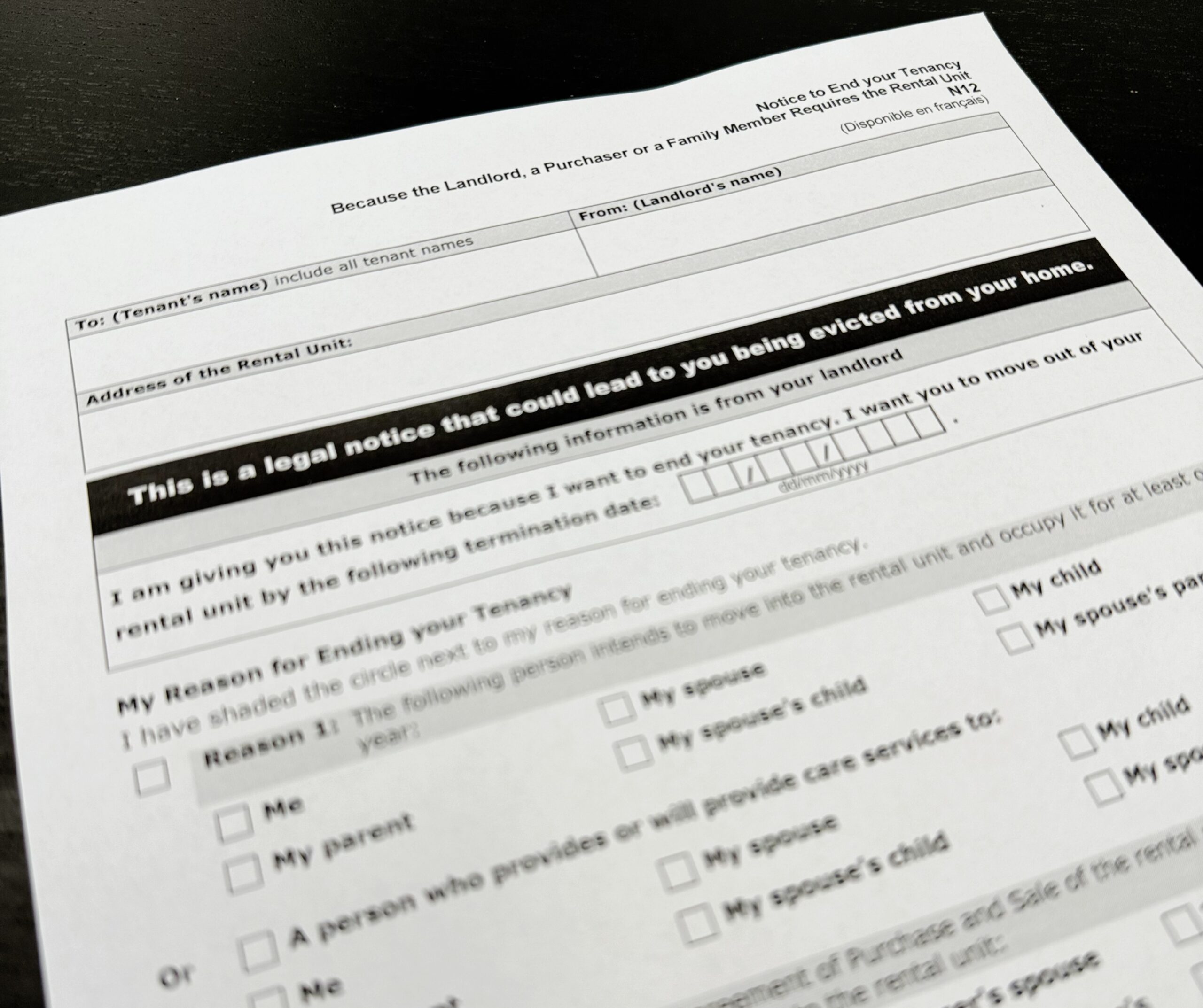
The N12 form, officially called the “Notice to End your Tenancy Because the Landlord, a Purchaser, or a Family Member Requires the Rental Unit,” is the notice landlords must use when they need to reclaim a rental unit for personal use or for a family member. Understanding how to complete this form correctly is essential, as errors can lead to your application being dismissed at the Landlord Tenant Board.
Who Can Move Into the Rental Unit Under an N12 Notice?
The N12 notice can be used when the landlord requires the rental unit for:
• The landlord themselves
• The landlord’s spouse or common-law partner
• The landlord’s children or parents
• The landlord’s spouse’s children or parents
• A person who provides or will provide care services to any of the above
• A purchaser of the property who intends to occupy the unit (or their spouse, children, or parents)
The person who moves into the unit must genuinely intend to live there for at least one year. Filing a bad faith N12 notice can result in the landlord being ordered to pay the tenant up to one year’s rent as a penalty under the Residential Tenancies Act.
How to Fill Out the N12 Form
The N12 form requires:
Landlord and Tenant Information – Full legal names of both parties as they appear on the lease agreement.
Rental Unit Address – The complete address of the rental unit, including unit number.
Reason for the N12 – You must select the specific reason: landlord’s own use, family member’s use, purchaser’s use, or caregiver’s use. You must also identify the specific person who will be moving into the unit.
Termination Date – The termination date must be at least 60 days after you serve the notice AND must coincide with the last day of the lease term or the last day of a rental period. For example, if your tenant pays rent on the 1st of each month, the termination date must fall on the last day of a month (e.g., March 31, April 30).
N12 Notice Period: How to Calculate 60 Days
The 60-day notice period is calculated from the date the tenant receives the notice, not from when you write it. The termination date must also align with the end of a rental period or lease term.
For example: If you serve the N12 on January 15 and the tenant pays rent on the 1st of each month, the earliest termination date would be March 31 (not March 15), because the termination must coincide with the end of a rental period. This catches many landlords off guard and is a common reason N12 notices are challenged.
Where to Download the N12 Form
The N12 form is available for free on the Landlord Tenant Board website. You can download it from the Social Justice Tribunals Ontario forms page.
We strongly recommend having a legal professional review your N12 notice before serving it. The N12 is frequently challenged by tenants, and any error in the form or the termination date calculation can result in your application being dismissed. Contact Sturino Walker Legal at 905-738-7171 for a free consultation.
Common Questions About how to Evict a Tenant for Personal Use Ontario:
Can you evict a Tenant for a family member to move in?
Yes, landlords in Ontario can evict tenants if they or their immediate family members (including parents and children) plan to occupy the unit. The same process and forms apply.
What is the notice period to evict a tenant for personal use Ontario?
The notice period is at least 60 days after you give the Tenant the N12 Notice. The termination date must coincide with the end of the lease term or the rental period.
What happens if you don’t give 60 days notice in Ontario?
If an Ontario landlord fails to give a 60-day notice for termination, several legal repercussions could follow. Under the Residential Tenancies Act, the tenant is not required to vacate without proper notice. If you were to file the application without giving 60 days’ notice, it would be dismissed in court
How much money does a Landlord have to give a Tenant to move out?
In Ontario, when a landlord wants to evict a tenant for personal use Ontario, the landlord is legally required to provide one month’s rent compensation to the tenant. The payment must be given to the tenant before the termination date specified in the eviction notice. This financial requirement is intended to assist the tenant in covering moving expenses or the increased cost of new accommodations. This rule ensures a fair transition for tenants who need to vacate a property so that landlords can use it for their own purposes or for their immediate family members.

What eviction notice do I use to Evict a Tenant for Personal Use Ontario?
To evict a tenant for personal use Ontario, landlords must use Form N12, titled “Notice to End your Tenancy For Landlord’s or Purchaser’s Own Use.” The Landlord Tenant Board provides this form, which can be found here.
What should a landlord do if a tenant refuses to vacate after the notice period?
If a tenant refuses to vacate after the N12 notice period, the landlord should apply to the Landlord Tenant Board. Here, the Landlord can obtain an eviction order. The sheriff will enforce this order if necessary.
Can you evict a Tenant without a lease in Ontario?
Yes. Even without a written lease, a landlord tenant relationship exists in Ontario as long as rent has been exchanged. Under the Residential Tenancies Act, verbal and implied tenancy agreements are legally binding, and the same eviction rules apply. If a previous lease has expired and the tenant is now month-to-month, all the original lease terms continue to apply. To evict a tenant without a lease for personal use, you must still serve the N12 notice with at least 60 days’ notice, provide one month’s rent compensation, and file an L2 application with the Landlord Tenant Board if the tenant does not leave. The process is identical whether there is a written lease or not.
Is a text message considered written notice in Ontario?
No. A text message is not considered valid written notice under the Residential Tenancies Act for the purpose of serving eviction notices. The Landlord Tenant Board requires that notices be served using specific methods: personal delivery to the tenant, delivery to another adult in the rental unit, sliding the notice under the door, leaving it in the mailbox, courier, fax, or regular mail. You cannot serve an N12 notice by text message, email (unless the lease specifically permits email service), or by taping it to the door. Using an invalid service method can result in your notice being challenged and your application being dismissed at the LTB hearing.
What reasons can you evict a Tenant in Ontario?
In Ontario, a landlord can evict a tenant on several grounds as stipulated by the Residential Tenancies Act. These grounds include non-payment of rent, persistent late payment, and significant damage to the property. Other reasons are illegal activities on the premises, substantial interference with others’ rights, and eviction for personal use. Each ground requires landlords to follow specific procedures and provide proper notice. This ensures the eviction process is fair and legal.
How to evict a Tenant immediately in Ontario?
Immediate eviction is extremely rare in Ontario. Even in serious cases such as illegal activity or threats to safety, the landlord must follow the Landlord Tenant Board process. However, in urgent situations, the Board may schedule an expedited hearing. For a standard personal use eviction using the N12 notice, the minimum timeline is 60 days from when the notice is served, plus the time required to obtain a hearing date and eviction order. The fastest way to move through the process is to ensure all paperwork is completed correctly from the start and to hire professional representation. Contact Sturino Walker Legal at 905-738-7171 to begin the process immediately.
Learn more about how a Landlord can evict a Tenant in Ontario by reading our article “13 Reasons to Evict a Tenant in Ontario”

Related Articles:
- How Late Can a Tenant Pay Rent in Ontario?
- 13 Reasons to Evict Your Tenant in Ontario
- Evict A Tenant for Not Paying Rent Ontario
- Landlord Legal Services Ontario
We’re Here to Assist with Landlord Tenant Matters – Request a Free Consultation Today
Legal issues with your rental property can be stressful. Our firm is committed to providing you with the support you need. Contact us for a complimentary consultation to explore how we can help you achieve a favourable outcome at the Landlord and Tenant Board.

Updated March 2026