
5 Ways to Collect Unpaid Rent After Tenant Moves Out

Last Updated:
| 17 Minutes To Read

Quick answer: How to collect unpaid rent after tenant moves out Ontario landlords have five routes. File an L10 application at the Landlord and Tenant Board within one year of the move-out. Sue in Small Claims Court when that window has closed. Garnish the former tenant’s wages or bank account once you hold an order or judgment. Register a writ of seizure and sale against their assets. Or hand the debt to a licensed collection agency. The LTB and Small Claims Court each cap awards at $50,000. The keys came back, but the debt did not.
When a tenant skips out owing money, the debt does not leave with them. If you are working out how to collect unpaid rent after tenant moves out, Ontario law gives landlords five routes, and the right one turns on timing and the size of the balance. The same non-payment eviction in Ontario process that ended the tenancy may have already produced an order you can enforce. If it did not, the money is still collectible. The unit is empty. The debt is not gone. This guide walks through all five routes, in the order most landlords should weigh them.
Sturino Walker Legal Services is a landlord-only paralegal firm based in Toronto. We recover rent and damages for landlords across Ontario, from L10 applications at the Landlord and Tenant Board through to garnishment and asset seizure. Everything below reflects current Ontario procedure. Call 905-738-7171 for a case review.

Start Here: Can You Still Collect Unpaid Rent After a Tenant Moves Out?
Yes. The end of a tenancy does not erase the debt. A common myth says the Landlord and Tenant Board shuts its doors the moment a tenant hands back the keys. That is wrong. Since September 1, 2021, the LTB hears claims against former tenants through the L10 application. So you have a choice of routes, not a dead end.
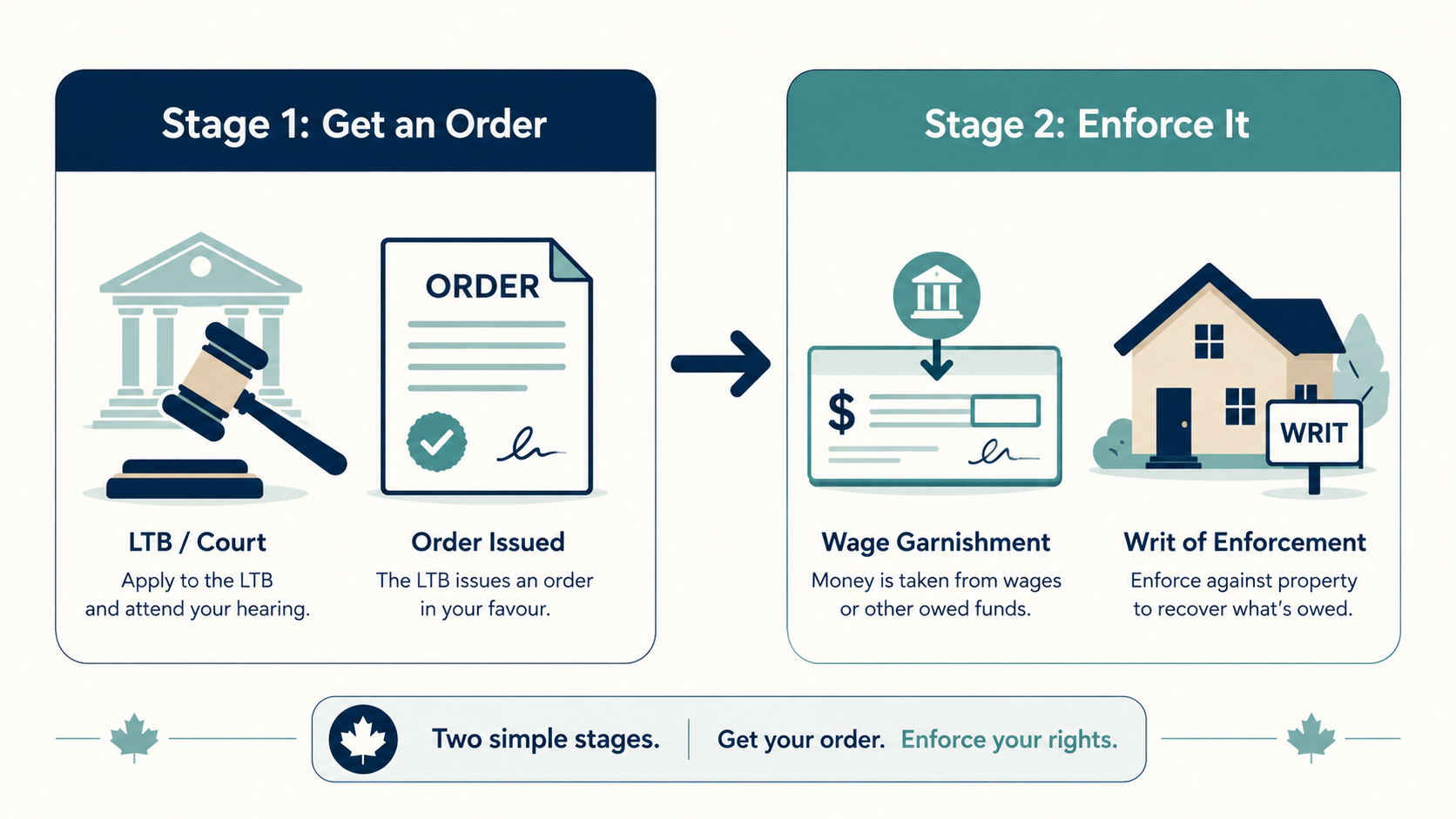
Before you pick one, understand the two stages of collection. Stage one is getting an order or judgment that fixes what the former tenant owes. Stage two is enforcing that order to turn it into real money. The L10 application and Small Claims Court are stage-one routes. Garnishment and a writ of seizure and sale are stage-two enforcement tools. A collection agency can run alongside either stage.
Two numbers frame every decision. The LTB can order up to $50,000. Small Claims Court also handles claims up to $50,000. Neither is a higher court than the other for this purpose. If a former tenant owes more than $50,000 and you want the full amount, the Superior Court of Justice is the venue, and you should get advice first.
The five routes below move from getting the order to enforcing it. Most landlords start with route one or two, then use the rest to collect.
Way 1: File an L10 Application at the Landlord and Tenant Board
The L10 application (Application to Collect Money a Former Tenant Owes) is the LTB’s purpose-built tool to collect unpaid rent after a tenant moves out. Ontario wrote this route into the Residential Tenancies Act so landlords no longer lose the tribunal once the tenant leaves.
Two conditions set the boundaries. The former tenant must have moved out on or after September 1, 2021. And you must file within one year of the move-out date. Miss the one-year deadline and the L10 door closes. Small Claims Court becomes your route instead.
The L10 reaches more than base rent. You can claim unpaid rent from during the tenancy, compensation for any period the tenant stayed after the tenancy ended, NSF charges, unpaid utilities the tenant was responsible for, the cost of damage beyond normal wear, and costs from substantial interference with your reasonable enjoyment of the property.
Because the LTB is the tribunal with authority over residential tenancy matters, the L10 is generally the correct first route while the one-year window is open. File it, serve the former tenant, attend the hearing, and ask the Board to order payment. The LTB’s L10 brochure sets out the service rules. The order it issues is enforceable, and you collect on it through routes three and four.
If the tenant was still in the unit before they left, this may have started as a standard non-payment eviction in Ontario; worth checking whether an N4 or L1 was ever served.
Way 2: Sue in Small Claims Court
Small Claims Court is the route to collect unpaid rent after a tenant moves out when the L10 is not available or no longer fits. Two situations make it the right call. The one-year LTB deadline has passed. Or the tenant moved out before September 1, 2021. Small Claims also handles related claims that sit outside what the L10 covers.
The limitation period here is longer. You generally have two years from the date you knew about the loss to start a Small Claims action. That buys time the L10’s one-year clock does not. The court’s limit is $50,000, the same as the LTB. So Small Claims is a different forum, not a bigger one.
The process is a claim, not an application. You file a Plaintiff’s Claim, serve the former tenant, and either settle or go to a hearing. Win, and the court issues a judgment. Like an LTB order, that judgment is enforceable through garnishment and a writ.
Way 3: Garnish the Former Tenant’s Wages or Bank Account
Garnishment is the first enforcement tool, and for most landlords it is the most effective. It is not a new application. It runs on an order or judgment you already hold from route one or two.
Garnishment redirects money the former tenant is owed by someone else straight to you. Two targets do most of the work. Wage garnishment takes up to 20 percent of the tenant’s pay each period until the debt clears. Bank garnishment pulls funds directly from the tenant’s account.
The process runs through Small Claims Court even when the underlying order came from the LTB. You file the LTB order with the court, complete the garnishment paperwork, and serve it on the employer or bank and on the former tenant. The Small Claims Court after-judgment guide sets out the forms. The employer or bank is then legally required to hold and remit the money.
Garnishment depends on information. You need to know where the former tenant works or banks. If you do not, an examination hearing lets you question the debtor about income, accounts, and assets, and a skip trace can locate an employer when the tenant has moved on.
Garnishment is steady rather than instant. Once it is running, it tends to deliver consistent recovery, paycheque by paycheque.
Way 4: Register a Writ of Seizure and Sale
A writ of seizure and sale is the second enforcement tool. Like garnishment, it runs on the order or judgment you already have. It reaches assets rather than income.
There are two kinds. A writ of seizure and sale of personal property lets the court’s enforcement office seize and sell a former tenant’s belongings, such as a vehicle, to satisfy the debt. A writ of seizure and sale of land is registered against any real estate the former tenant owns. In practice the land writ rarely ends in a forced sale. It acts as a lien. The debt usually gets paid when the former tenant sells or refinances, because a buyer wants clear title.
You file the writ through Small Claims Court using your order or judgment, then direct the enforcement office to the specific property. Fees and a deposit apply, and you carry the upfront enforcement costs, which you can add to the debt.
A writ works best when you know the former tenant owns something worth reaching. For a tenant with a car, a home, or other assets, it is a strong tool. For a tenant who rents and owns little, garnishment is usually the better bet. Many landlords run a writ and a garnishment at the same time. They are not mutually exclusive.
Way 5: Hire a Licensed Collection Agency
A collection agency is the route that needs no order and no court. You can hand the debt to a licensed agency before, during, or instead of the LTB and court process.
The agency pursues the former tenant on your behalf. It traces their location, contacts them, negotiates payment, and can report the unpaid debt to the credit bureaus. That credit consequence is often what moves a former tenant to pay, because the debt then follows them into every future rental application and loan.
Agencies work on commission, usually a percentage of what they recover. You keep less per dollar than you would enforcing an order yourself, but you spend no time chasing the debt. A percentage of something beats all of nothing.
One Ontario-specific point. You cannot report a former tenant’s debt to the major credit bureaus yourself. It has to run through an authorized platform or a licensed agency. Keep that in mind if credit reporting is your main goal.
A collection agency pairs well with a judgment. Hand the agency a debt already confirmed by an LTB order or court judgment and it carries far more leverage than an unproven claim.

Is Chasing a Former Tenant’s Debt Worth It?
Not every debt is worth chasing, and an honest answer serves you better than a hopeful one. The hard truth is that some former tenants are judgment-proof. A tenant with no steady wages, no bank balance, and no assets can owe you an order and still have nothing to take.
Weigh three things before you spend money on recovery. First, the size of the debt against the cost and time of each route. Second, what you know about the former tenant’s job, accounts, and assets, because enforcement only works when there is something to reach. Third, the deadlines, since the L10’s one-year window and the two-year limitation period both close.
Even so, do not write a debt off too quickly. A judgment in Ontario stays enforceable for years, and circumstances change. A former tenant who is broke today may have a job and a bank account next year. The order waits. A registered land writ waits too, and collects when the property changes hands.
The strongest position is an enforceable order in hand, good information about the former tenant, and a clear-eyed view of the odds. That is the combination we build for landlords every week.
Common Mistakes When Collecting Unpaid Rent After Move-Out
Most failed collections trace back to a handful of avoidable errors. Each one below quietly kills an otherwise winnable recovery.
Missing the one-year L10 deadline
The L10 must be filed within one year of the move-out date. Landlords who wait, hoping the tenant pays on their own, watch the LTB route expire. Once it does, Small Claims is the only door left.
Filing in the wrong forum
Running to Small Claims when an L10 is available, or trying the LTB after the one-year window has closed, both waste time and money. Match the route to the timing first.
Thin documentation
A clean rent ledger, the lease, the move-out record, and every message win cases. Vague figures lose them. The adjudicator orders what you can prove, not what you claim.
Trying to collect through self-help
Keeping a tenant’s belongings as ransom, or harassing them for payment, is illegal in Ontario and can turn your claim into their counterclaim. Use the legal routes. They work.
When to Hire a Paralegal
Ontario lets landlords file their own L10, run their own Small Claims claim, and handle their own enforcement. Many try. That does not make going alone the smart play once a tenant has left owing money.
Collecting from a former tenant is the stage where small errors cost the whole debt. Here is what is at stake when a landlord goes in alone:
• The deadline runs out. Miss the one-year L10 window and you lose the faster tribunal route entirely.
• The wrong forum stalls everything. Filing in Small Claims when the L10 was the proper route, or the reverse, can mean starting over months later.
• The order is unenforceable in practice. Winning an order means nothing if you do not know where the tenant works or banks. We line up the enforcement information before the order is even issued.
• Enforcement paperwork gets rejected. Garnishments filed under the wrong employer name, or writs aimed at the wrong assets, get bounced. Each restart burns weeks.
• Good money chases bad. Spending on enforcement against a judgment-proof tenant is throwing money after money. We tell you when a debt is worth pursuing and when it is not.
When to call us
Engage a paralegal at any of these points:
• The moment a tenant moves out owing rent, so the one-year L10 clock is tracked from day one.
• When you are unsure whether the L10 or Small Claims is the correct route for your timing and claim.
• When you hold an order or judgment but cannot locate the former tenant’s employer, bank, or assets.
• Before you file a garnishment or writ, so it is served correctly the first time.
• When the debt is large enough that a wrong move would be expensive, or when you want an honest read on whether it is collectible at all.
Sturino Walker Legal Services files L10 applications, runs Small Claims claims, and handles garnishment and writ enforcement for Ontario landlords. We work landlord-side only. You get a written fee estimate at the outset, so you know what you are committing to before you engage us. Call 905-738-7171 for a case review.

FAQ: Collecting Unpaid Rent After a Tenant Moves Out
Can I take a former tenant to the LTB after they move out?
Yes. Since September 1, 2021, the Landlord and Tenant Board hears claims against former tenants through the L10 application (Application to Collect Money a Former Tenant Owes). You must file within one year of the move-out date, and the tenant must have moved out on or after September 1, 2021. If those conditions are met, the LTB is open to you, despite a common myth that it closes once the tenant leaves.
What is an L10 application in Ontario?
The L10 is the LTB form a landlord uses to collect money a former tenant owes after they have moved out. It can claim unpaid rent, compensation for time the tenant stayed after the tenancy ended, NSF charges, unpaid utilities the tenant was responsible for, damage beyond normal wear, and costs from substantial interference. The Board can order up to $50,000.
How long do I have to collect unpaid rent from a former tenant in Ontario?
It depends on the route. The L10 application at the LTB must be filed within one year of the move-out date. A claim in Small Claims Court generally has a two-year limitation period from the date you knew about the loss. Track both deadlines, because missing the one-year LTB window pushes you to the court route.
Can I sue a former tenant for unpaid rent in Small Claims Court?
Yes, and Small Claims is the usual route once the one-year LTB window has closed or the tenant moved out before September 1, 2021. The court handles claims up to $50,000, the same limit as the LTB. Because the LTB has authority over residential tenancy matters, get advice on the correct forum before choosing Small Claims over an available L10.
How do I garnish a former tenant’s wages in Ontario?
You need an order or judgment first, from either an L10 at the LTB or a Small Claims claim. You then file the order with Small Claims Court, complete the garnishment paperwork, and serve it on the employer or bank and on the former tenant. Wage garnishment can take up to 20 percent of the tenant’s pay each period until the debt is paid.
Can I report a former tenant’s unpaid rent to the credit bureau?
Not directly. In Ontario, landlords cannot report rental debt straight to the major credit bureaus. Reporting runs through an authorized platform or a licensed collection agency. Because the debt then follows the former tenant into future rental and loan applications, credit reporting is often what finally prompts payment.
What if the former tenant has no money or assets?
Some former tenants are judgment-proof, with no steady wages, bank funds, or assets to reach. Enforcement cannot pull money that is not there. The good news is that an Ontario judgment stays enforceable for years. A tenant who is broke today may have a job or a bank account later, and a registered land writ can collect if they ever own property.
Is the LTB limit or the Small Claims limit higher for unpaid rent?
Neither. Both the Landlord and Tenant Board and Small Claims Court cap awards at $50,000. Small Claims rose to that figure on October 1, 2025, matching the LTB. If a former tenant owes more than $50,000 and you want the full amount, the Superior Court of Justice is the venue, and you should get advice before filing.
Related Articles
- Evict a Tenant for Personal Use Ontario
- 13 Reasons to Evict Your Tenant in Ontario
- Evict A Tenant for Not Paying Rent Ontario
- Landlord Legal Services Ontario
Protect Your Rights Book a Free Consultation Today
Don’t go through the Landlord and Tenant Board process alone. Reach out for a free consultation with our skilled legal professionals who can guide you every step of the way.





