
7 Facts to Know About Ontario’s Speed Limit Increase

Last Updated:
| 7 Minutes To Read
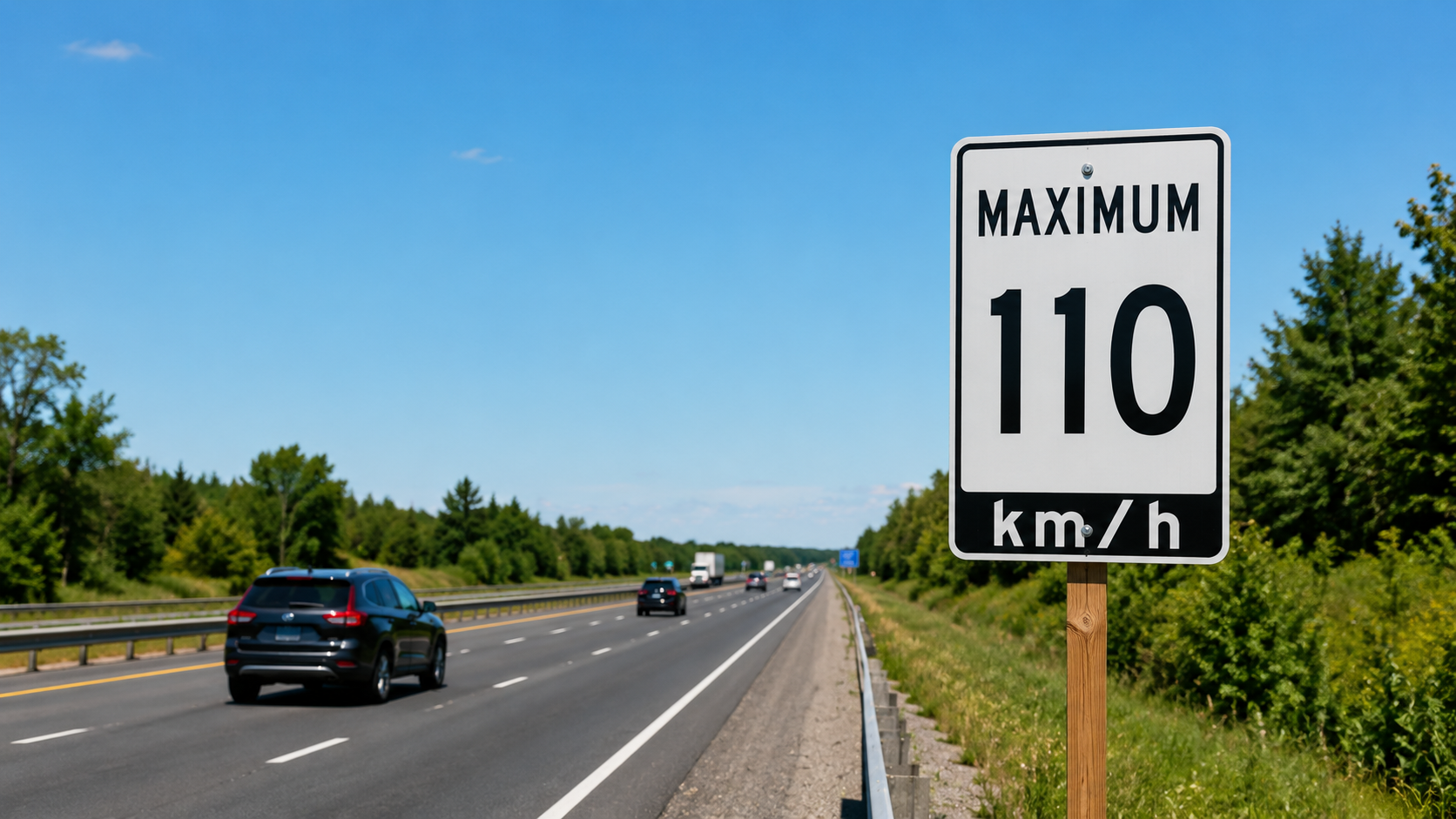
Quick answer: Ontario is raising the speed limit from 100 km/h to 110 km/h on another 938 kilometres of provincial highways. The Ontario speed limit increase rolls out in stages between June 26 and September 30, 2026. It covers sections of Highways 401, 402, 403, 407, 416, 417, and the QEW. The stunt driving threshold does not move with it. Call Sturino Walker Legal Services at 905-738-7171 if you are fighting a speeding or stunt driving ticket.
More of Ontario’s highways just got faster. The Ontario speed limit increase moves another 938 kilometres of provincial highway from 100 km/h to 110 km/h. The change rolls out in stages through September 30, 2026. By the end of that rollout, roughly 89 percent of the network will post 110 km/h. That is up from 43 percent before the announcement.
Drivers have real questions. Which highways change first? Where is the map? Does going faster now mean a speeding ticket, or a stunt driving charge, is easier to earn by accident? Below are 7 facts that answer those questions, plus what to do if you already have a ticket.
What Is the Ontario Speed Limit Increase?
The Ontario speed limit increase is a staged change to the posted limit on select provincial highways. It moves the limit from 100 km/h to 110 km/h. Transportation Minister Prabmeet Sarkaria announced it on June 24, 2026, at a news conference in King City.
This is not a new policy direction. Ontario raised limits on six highway sections in 2022 and ten more in 2024. This round adds 938 kilometres on top of the 873 kilometres already posted at 110 km/h. Together, that reaches roughly 89 percent of the network by late September 2026.
Why Is Ontario Raising the Speed Limit?
The province says most of its highway network was originally engineered for 110 km/h. The 2022 and 2024 increases showed no rise in fatalities on those sections. Raising the posted limit closer to the road’s actual design speed is the stated rationale.
Travel time is the second driver. The government estimates a Sarnia to Toronto trip saves close to 20 minutes once the higher limit is in place. A Toronto to Ottawa trip saves close to 30 minutes. Increases only apply after a technical review confirms a section can safely handle the higher speed.
| Effective date | Highways affected |
| June 26, 2026 | Hwy 401 (Hwy 15 to Hwy 16, Eastern Ontario); Hwy 416 (Cedar Grove Rd to Hwy 401) |
| July 31, 2026 | Hwy 402 (two sections near Sarnia) |
| August 21, 2026 | Hwy 7; Hwy 115; Hwy 400; Hwy 416 (additional section); Hwy 417 (two sections) |
| August 31, 2026 | Hwy 401 (five sections, Windsor–Belleville corridor); Hwy 403 (Woodstock area) |
| September 30, 2026 | Hwy 403; Hwy 404; Hwy 406; Hwy 407 East (Brock Rd to Hwy 35/115, public section); Hwy 412; Hwy 418; QEW (three sections) |
Where to Find the Ontario Speed Limit Increase Map
The Ontario Ministry of Transportation publishes an official map of the rollout. It shows sections already at 110 km/h, sections changing now, and future expansion projects still under construction. Check that map directly on the Ontario Newsroom backgrounder. New sections are still being added through September 2026.
Does the Ontario Speed Limit Increase Change Stunt Driving Rules?
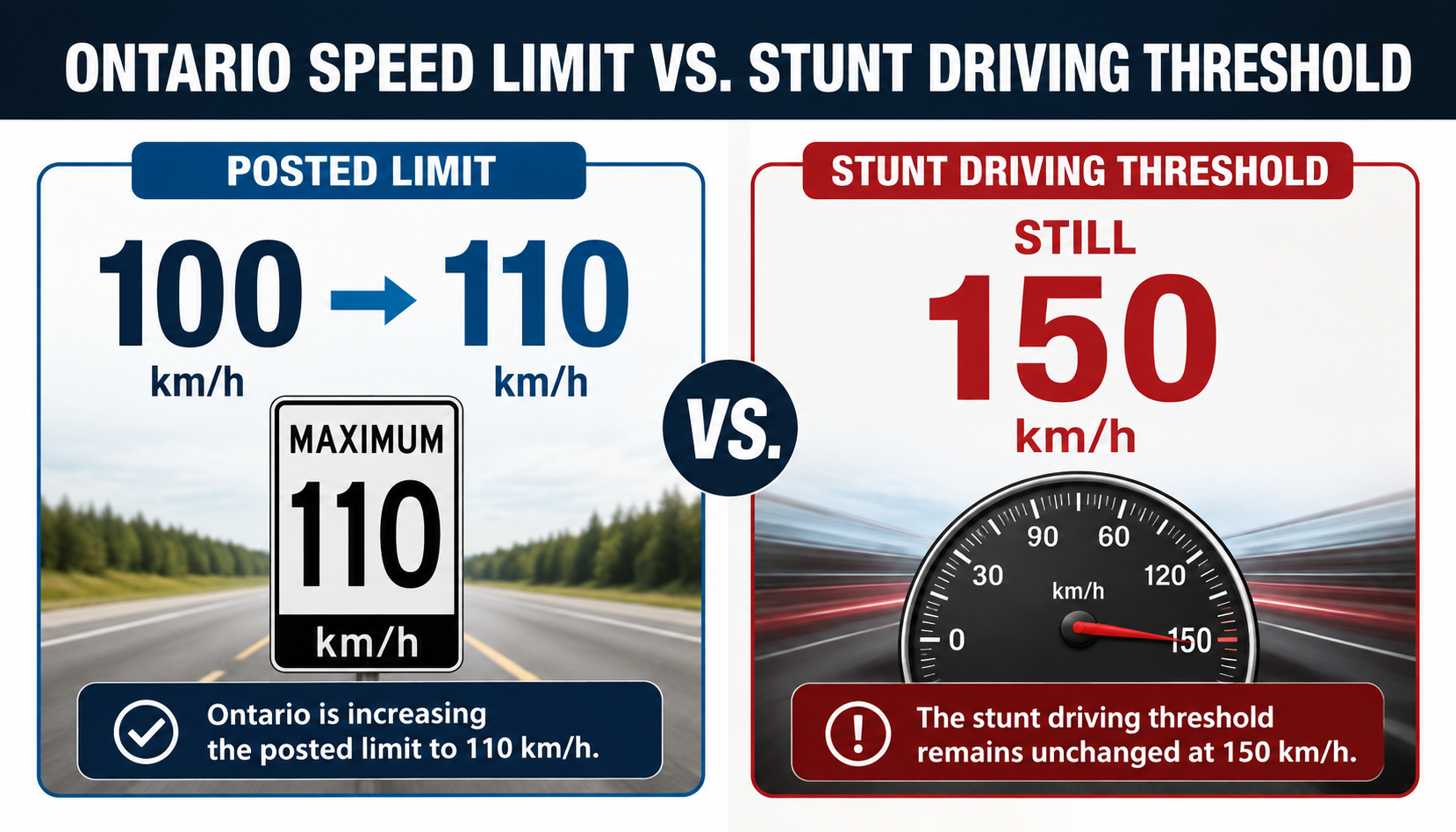
No. The Ontario speed limit increase does not change the stunt driving rules. Ontario Regulation 455/07 still sets the same speed triggers for a stunt driving charge. That’s true no matter what the posted limit is.
Two rules matter most for highway driving. The first: 50 km/h or more over the posted limit is stunt driving. That applies on any highway posted at 80 km/h or higher. The second: 150 km/h or more is always stunt driving, no matter what the posted limit is.
Here’s where it gets confusing on the new 110 km/h highways. Fifty over 110 works out to 160 km/h. But the flat 150 km/h rule kicks in first, at a lower speed. So even though the “50 over” math says 160, the real charge can come 10 km/h sooner, at 150.
On the old 100 km/h highways, this gap didn’t exist. Fifty over 100 is exactly 150, so both rules pointed to the same number. The 110 km/h increase is what creates the gap.
The takeaway: on a 110 km/h highway, treat 150 km/h as the real line, not 160. A stunt driving charge brings an immediate 30-day licence suspension and vehicle impoundment at roadside. That happens before you ever see a courtroom. For the full breakdown of penalties, see our guide: 13 Stunt Driving Ontario Facts.
What Is the Speed Limit on Highway 401 Now?
The Ontario speed limit increase touches the 401 more than any other route. Highway 401 is not a single speed limit anymore. Two sections between Highway 15 and Highway 16 in Eastern Ontario moved to 110 km/h on June 26, 2026. More 401 sections follow on August 31, 2026, including stretches near Cobourg, Belleville, and Windsor. A Greater Toronto Area section joins on September 30, 2026.
Watch the posted signs closely on the 401 through the summer and fall of 2026. A single trip can cross older 100 km/h stretches and newly posted 110 km/h stretches in the same drive.
Which Province Has the Highest Speed Limit in Canada?
British Columbia currently posts the highest limits in the country. Sections of the Coquihalla Highway sit at 120 km/h. Ontario’s 110 km/h brings it in line with most other provinces rather than ahead of them. The Ontario speed limit increase does not change that national ranking. Ontario has no announced plan to move past 110 km/h on any provincial highway.
Got a Ticket During the Rollout? Here’s What to Know
Yes, you can still be ticketed on a section that hasn’t changed yet. The increase rolls out highway by highway, not all at once, so one stretch of the 401 can sit at 110 km/h while the very next stretch is still posted at 100 km/h.
It’s an easy mistake. Seeing the news and assuming the whole highway changed is a natural assumption, but it’s the posted sign that controls, not the headline. That mix-up doesn’t automatically make a ticket invalid, but it’s worth a real review. Call 905-738-7171 for a free consultation before you pay it.

When to Call Us
Call 905-738-7171 at any of these points:
• You received a speeding ticket on a highway section you believed was already at 110 km/h.
• You were charged with stunt driving on a highway where the posted limit recently changed.
• You are not sure whether your ticketed location falls in an updated or not-yet-updated section.
• Your ticket shows a speed close to the 150 km/h stunt driving threshold.
Sturino Walker Legal Services represents drivers fighting speeding and stunt driving tickets across the GTA and the rest of Ontario. We work from our office in Etobicoke. The Ontario speed limit increase keeps rolling out through September 2026. Transition-zone tickets are exactly the kind of case where a second look genuinely helps.
FAQ – Ontario Speed Limit Increase
Why is Ontario raising speed limits?
The province says most of its freeway network was engineered for speeds above 100 km/h. Its 2022 and 2024 pilot increases showed no rise in fatalities on those sections. The government also points to travel time savings. It estimates close to 20 minutes saved between Sarnia and Toronto. A Toronto to Ottawa trip saves close to 30 minutes.
What are the new speed limits in Ontario?
The base highway limit is rising from 100 km/h to 110 km/h on 938 kilometres of provincial highway. It rolls out in five batches between June 26 and September 30, 2026. That adds to the 873 kilometres already posted at 110 km/h from the 2022 and 2024 rounds. Together, that reaches roughly 89 percent of the provincial network.
What highways in Ontario are going to 110 km/h?
Sections of Highways 401, 402, 403, 404, 406, 407, 412, 416, 417, and 418 are included. So is the QEW. The Highway 407 stretch in this rollout is the public, government-operated extension east of Brock Road. It is not the privately tolled 407 ETR. New freeways like Highway 413 and the Bradford Bypass are being built for 110 km/h from the start. Not every section of each highway changes, so check the exact stretch before assuming a full highway is affected.
Where can I find the Ontario speed limit increase map?
The Ontario Ministry of Transportation publishes an official map on the Ontario Newsroom backgrounder page. It shows existing 110 km/h sections, new sections, and future expansion projects. That map is the most current source, since sections are still being added through September 2026.
Is Ontario raising the speed limit to 120 km/h?
No. The current increase tops out at 110 km/h. Ontario has not announced any plan to move past that on a provincial highway. British Columbia currently posts Canada’s highest limit, at 120 km/h on parts of the Coquihalla Highway.
What is the speed limit on Highway 401 now?
It depends on the section. A stretch in far Eastern Ontario, between Highway 15 and Highway 16, moved to 110 km/h on June 26, 2026. A bigger stretch follows on August 31, 2026. It runs from Merlin Road near Windsor to Highway 427 at the GTA’s edge. The busiest stretch runs through Toronto and Mississauga, between Highway 427 and Highway 404. That stretch is not part of this rollout and stays posted at 100 km/h.
Which province in Canada has the highest speed limit?
British Columbia, with sections of the Coquihalla Highway posted at 120 km/h. Ontario’s move to 110 km/h brings it roughly in line with Alberta, Saskatchewan, and Manitoba. It does not put Ontario ahead of the rest of the country.
Can I still get a speeding ticket on a highway that hasn’t changed yet?
Yes. The increase applies section by section, not to an entire highway at once. A stretch that has not reached its rollout date is still enforced at 100 km/h. If you received a ticket on a stretch you believed had already changed, call 905-738-7171 first. We offer a free consultation before you decide anything.
Related Articles:
- The Demerit Point System
- Traffic Tickets Toronto
- 11 Careless Driving Ontario Facts: Penalties & Fines
- 13 Stunt Driving Ontario Facts: Speed, Penalties & Fines
- Stop Sign Ticket Ontario: $110 Fines & 3 Demerit Points
- 7 Red Light Ticket Ontario Facts: Camera vs Officer Fines
Need Professional Advice? Contact Us Today!
Sturino Walker Legal Services represents drivers fighting speeding and stunt driving tickets across Toronto and the GTA. The Ontario speed limit increase keeps rolling out through September 2026. Transition-zone tickets are exactly the kind of case where a second look helps. If you have a ticket tied to the speed limit increase, reach out for a free consultation. The same goes for any other traffic matter. Call 905-738-7171 today.





